US Foreign Policy Towards the Middle East: The Realpolitik of Deceit by Bernd Kaussler & Glenn P. Hastedt
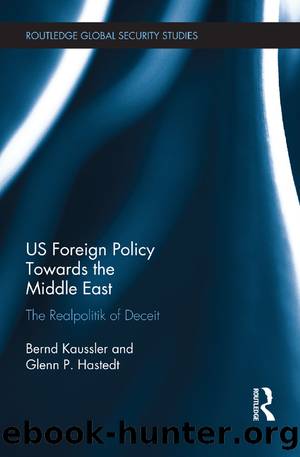
Author:Bernd Kaussler & Glenn P. Hastedt [Kaussler, Bernd & Hastedt, Glenn P.]
Language: eng
Format: epub
Tags: International Relations, General, Political Science, Middle East, History, Security (National & International)
ISBN: 9781317335962
Google: 5CMlDwAAQBAJ
Goodreads: 34645341
Publisher: Routledge
Published: 2016-06-30T00:00:00+00:00
Conclusion
While Saudi Arabia remained the second largest importer of crude oil to the US market, constituting 11 percent of all US gross petroleum imports in 2015, environmental policies adopted by the Obama administration and domestic oil production reduced overall US dependency on foreign oil.136 Between 2008 and 2013, oil imports from OPEC producers, including Persian Gulf states, fell by 40 percent and imports from Saudi Arabia in particular declined by 13 percent.137 While energy security will remain an important variable in USâSaudi relations, the rise of global crude supplies due to the US shale oil boom and the unlocking of offshore reserves in Brazil, Africa and Asia overall reduced US energy dependency toward Saudi Arabia.138 In addition, once legal and political frameworks will allow Iranian and Iraqi oil production and exports to increase, global crude prices are likely to decrease further. The drop from $139 per barrel for crude oil in 2008 to below $50 in 2016 constituted a systemic shock to the Saudi political economy and will require large-scale diversification efforts. Any such initiatives that would necessarily have to end the rentier stateâs subsidies will carry serious consequences for Saudi Arabiaâs regime durability. As the house of Saud is carefully maneuvering to rewrite the historic social-political contract, underwritten by oil rents and Wahhabi ideology, domestically, the changing regional dynamics and feared US disengagement from the Middle East have also informed Saudi foreign policy.139 Effectively, the Saudi regime upheld a narrative about the Shiâa threat emanating from Iran. The perceived external threat was to mobilize Saudi citizens and rally around the flag to shore up regime legitimacy. Particularly driven by the realities of newly emerging regional realignments after 2003 and 2011, Saudi foreign policy was intrusive and sought to maintain a balance against the perceived IranianâSyrianâIraqi axis. To that end, Saudi Arabia provided military, political and economic means and demarcated conflicts in Bahrain, Yemen and Syria along sectarian lines. Throughout the insurgency in Iraq, US officials sought for Saudi Arabia to engage in Iraqi politics and help curb the sectarian violence and promote political dialogue. Far from playing a positive role, the Saudi authorities failed to stem the flow of its nationals joining Salafist groups in Iraq; nor were they willing to assist in US and Iraqi stabilization and reconciliation efforts.140 By mid-2016, over 2,500 Saudi nationals had joined ISIS, making the country the second largest source of the terrorists groupâs foreign fighters.141 Overall, Saudi policies constituted a destabilizing variable for regional security and ultimately US interests. In realist terms, Saudi Arabia maintains friendly relations with the USA but ultimately it does not constitute an ally. Throughout the Cold War, Saudi Arabia has remained a strategic partner of the USA and served US interests, but it never constituted an ally in the realist meaning of the word. The USA had never had a formal alliance with treaty obligation with Saudi Arabia.142 With the geopolitical realities of the Cold War gone and over a decade of total war in Iraq, the
Download
This site does not store any files on its server. We only index and link to content provided by other sites. Please contact the content providers to delete copyright contents if any and email us, we'll remove relevant links or contents immediately.
| Arms Control | Diplomacy |
| Security | Trades & Tariffs |
| Treaties | African |
| Asian | Australian & Oceanian |
| Canadian | Caribbean & Latin American |
| European | Middle Eastern |
| Russian & Former Soviet Union |
The Secret History by Donna Tartt(19089)
The Social Justice Warrior Handbook by Lisa De Pasquale(12190)
Thirteen Reasons Why by Jay Asher(8910)
This Is How You Lose Her by Junot Diaz(6887)
Weapons of Math Destruction by Cathy O'Neil(6280)
Zero to One by Peter Thiel(5802)
Beartown by Fredrik Backman(5754)
The Myth of the Strong Leader by Archie Brown(5508)
The Fire Next Time by James Baldwin(5446)
How Democracies Die by Steven Levitsky & Daniel Ziblatt(5219)
Promise Me, Dad by Joe Biden(5153)
Stone's Rules by Roger Stone(5088)
A Higher Loyalty: Truth, Lies, and Leadership by James Comey(4964)
100 Deadly Skills by Clint Emerson(4925)
Rise and Kill First by Ronen Bergman(4789)
Secrecy World by Jake Bernstein(4753)
The David Icke Guide to the Global Conspiracy (and how to end it) by David Icke(4720)
The Farm by Tom Rob Smith(4513)
The Doomsday Machine by Daniel Ellsberg(4490)
